

Permanent makeup
Permanent-makeup removal: what is and is not possible
In practice, removing permanent makeup means fading it rather than erasing it. The only substantial evidence concerns laser treatment, which needs several sessions and rarely leaves completely pigment-free skin. Beauty Rocío does not remove permanent makeup. This guide explains the available methods, their evidence and who may legally perform laser removal in Switzerland.
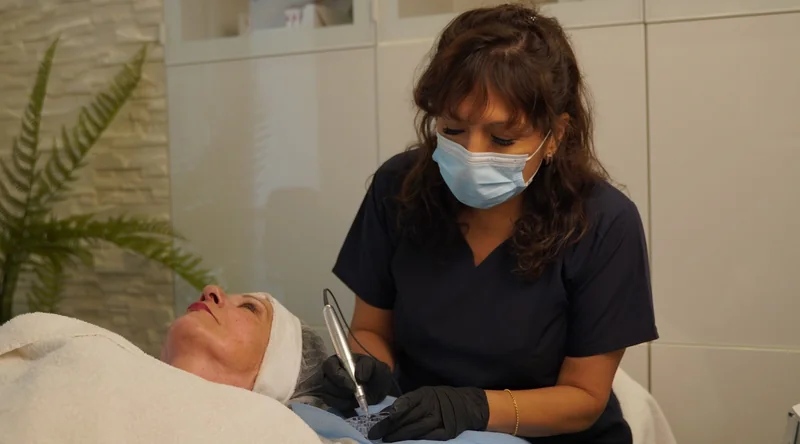
What is realistically possible
Pigment sits as a narrow band in the upper dermis. A laser pulse fragments particles and the body clears them over weeks, producing a lighter image rather than necessarily bare skin. Beauty Rocío neither offers nor removes microblading; once pigment is in the skin, the removal issues are broadly the same as for other brow pigment.
Published session estimates conflict. One review gives eight to fifteen, while a retrospective series of 76 eyebrow and eyeliner cases averaged 2.8, mainly with picosecond laser. A prospective study found that pre-treatment colour measurement did not predict session count. Fixed promises are therefore unsupported. Allow four to six weeks between sessions and judge a session only after about three months.
Complete clearance is exceptional. A ten-year tattoo-removal series reported it in 1.26 per cent after an average 3.57 sessions, but included many incomplete courses, older Q-switched treatment and skin types IV–VI, so the figure is not a ceiling on modern care.
Four methods compared
| Method | Mechanism | Evidence | Main reservation |
|---|---|---|---|
| Q-switched or picosecond laser | fragments pigment for biological clearance | case series and reviews; cosmetically preferable to older destructive methods | paradoxical darkening of light and skin-coloured pigment |
| Saline | creates a wound so pigment leaves with crusting | no clinical PMU study, case series or guideline found | scarring, itch, infection and pigment change |
| Chemical remover | alkaline solution introduced with a pigmentation device | one clinical study, as an adjunct to laser | undefined category and often undisclosed product |
| Skin-tone camouflage | adds a second pigment layer | no effectiveness or durability evidence found | skin-coloured pigment can darken under laser |
Laser evidence and colour-change risk
Q-switched lasers are the standard pigment-removal approach. Reviews suggest picosecond Nd:YAG may clear brow tattoos more quickly than Q-switched Nd:YAG and cause paradoxical darkening less often, but the basis is case series rather than comparative trials. Wavelength must match colour: 694/755 nm target black, blue and green; 1064 nm targets black and blue and penetrates more deeply; 532 nm targets red, orange, yellow and brown.
Laser energy can chemically reduce titanium dioxide and iron oxides, turning light, flesh-coloured, white or pink pigment black. These materials are common in PMU. A test spot is essential before treating a larger light-pigment area, though it cannot prevent the reaction and picosecond devices do not eliminate it. In the 76-case series, 26.3 per cent showed previously hidden colours after the first session, including red, orange, yellow, green and blue. This can be a treatment stage rather than an error.
Saline, removers and camouflage pigment
No clinical PMU-removal study or guideline for saline was found in PubMed or Europe PMC. It works by deliberate inflammation and an open wound, with potential scarring, chronic itch, infection and hypo- or hyperpigmentation. In a 2026 practitioner survey, 31 per cent had seen clients previously treated with an alternative method; 56.7 per cent of those practitioners had observed complications.
“Remover” is not a protected or standardised term. The one clinical study found used a sodium-hydroxide solution at pH 9–11 inserted with a pigmentation device, materially different from saline. Ask for product name, ingredients and pH. Skin-tone camouflage adds, rather than removes, pigment and may increase the risk of darkening if laser is attempted later.
How permanent makeup fades
PMU fades over years, but intentional sun, acids or abrasion are not controlled or skin-safe removal. Some pigment reaches regional lymph nodes early, while much remains measurable in the dermis. Visible fading may include a colour shift to blue, green, grey or red rather than disappearance. Waiting can make sense when shape is correct but colour is too strong, or while very new work heals fully. Beauty Rocío lists typical longevity as one to three years depending on technique, skin and sun exposure on its permanent-makeup page.
Who may remove it in Switzerland
Under V-NISSG Article 5, laser removal may be carried out by licensed doctors, directly supervised staff in their practices, or people holding the examined certificate of competence. The exact required certificate is “Permanent makeup and tattoo”, compulsory since 1 June 2024. “Skin and pigmentation” does not cover removal of introduced pigment. Ask to see the exact title. Cantons enforce the rules, and federal guidance cites fines up to CHF 40,000 for treatment without the certificate.
Pigment removal on eyelids and within ten millimetres of the eye is restricted to doctors or directly instructed practice staff, with internal eye shields under local anaesthesia. This includes every eyeliner. Federal guidance treats brows as outside the ten-millimetre zone, an administrative interpretation rather than statutory wording. Ablative and long-pulsed Nd:YAG lasers are also doctor-only.
IPL removal of PMU or tattoos is prohibited in Switzerland, including in medical practices, because federal guidance associates it with burns and disfiguring scars. Saline, chemical removers and camouflage do not use radiation and therefore fall outside V-NISSG. That lack of access barrier is not evidence of safety.
Before booking, ask for the exact certificate, device and wavelengths, test-spot protocol and plan if pigment darkens.
What Beauty Rocío does and does not do
Beauty Rocío performs no PMU removal by laser, saline or remover. Rocío Furger holds certificates for laser hair removal (2024) and skin and pigmentation (2025); neither authorises PMU removal.
A consultation costs CHF 50 for 45 minutes and is credited if a suitable treatment follows. We assess whether correction is possible; we currently do not overwork brows made elsewhere. Correction can only reshape within the existing pigment and cannot make very dark or broad brows smaller. When it is unsuitable, we recommend a dermatology practice or provider with the correct certificate. Existing Beauty Rocío brows may be refreshed for CHF 350.
Sources & review date
- Geisler et al.: Laser treatment of eyebrow cosmetic tattoo pigment – structured review.
- Kream et al.: Laser Removal of Eyeliner and Eyebrow Tattoos – retrospective series of 76 cases.
- Anderson et al.: Cosmetic tattoo ink darkening – case series and laboratory investigation.
- Swiss FOPH: V-NISSG enforcement guidance.
Sources reviewed: 24 August 2026.
Frequently asked questions
Can permanent makeup be removed completely?
Rarely. Literature describes gradual fading. A retrospective tattoo series reported complete clearance in 1.26 per cent, with important limitations. A clearly lighter image is more realistic than bare skin.
How many sessions are needed?
Published figures range from an average 2.8 in one 76-case series to eight to fifteen in review literature. No measured baseline factor reliably predicts the number, so reassessment after each session is essential.
Can PMU become darker during laser treatment?
Yes. Titanium dioxide and iron oxides in light pigments can turn black. A test area is essential but cannot eliminate the risk, even with picosecond devices.
Is saline removal gentler than laser?
No evidence establishes that. We found no clinical PMU study, while the method deliberately creates inflammation and an open wound with possible scarring and pigment changes.
Does Beauty Rocío remove permanent makeup?
No. We apply, correct and refresh PMU but do not remove it because the required certificate is not held. A consultation can establish whether a correction is realistic.
Can new PMU be applied after removal?
We found no robust evidence for one waiting interval. The removal provider must assess fully healed skin. Beauty Rocío does not pigment an area that has not completely healed.
Permanent makeup at the institute
Brows, eyeliner and lips by Rocío Furger. Every treatment begins with a consultation credited towards a suitable appointment; existing work is assessed honestly before any correction.
Permanent makeup and prices